


How to Make Your EV Car Loan More Affordable in 2026
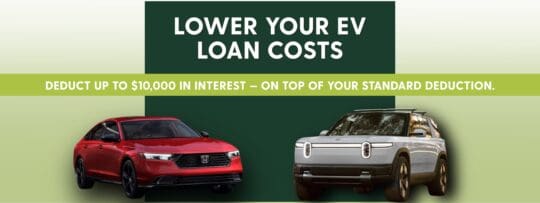
The One Big Beautiful Bill Act (OBBBA) includes a new $10,000 federal tax deduction for interest paid on qualifying U.S.-made, new car loans. This is a powerful tax shield that lowers monthly payments and makes financing EV loans more affordable.
The EV Car Loan Interest is an Above-the-Line Tax Deduction
An above-the-line deduction is a financial tool that enables you to qualify for other credits. It is an adjustment to income rather than a traditional itemized deduction. Normally, interest deductions—such as those for mortgage payments—require you to itemize, which often makes you ineligible for the Standard Deduction; however, the OBBBA changed the game by making EV interest an above-the-line adjustment.
This means the interest you pay is subtracted from your gross income before the IRS calculates your Adjusted Gross Income (AGI). Simply put, it lowers your AGI and makes it more likely you will qualify for other deductions.
Example: For a household in the 22% tax bracket, a $2,000 annual interest payment effectively costs $440 less after taxes.
How above-the-Line Deduction Saves Moderate Income Households Money
You don’t need to be a high-net-worth itemizer to see benefits with above-the-line deductions, so they are ideal for middle income households.
Double-Dipping: Taking the Standard Deduction While Also Claiming the Car Loan Interest Adjustment
Double-dipping is what makes this a massive financial win for moderate income earners. This means you can claim the full standard deduction ($15,750 for singles and $31,500 for joint filers). while simultaneously subtracting up to $10,000 in annual interest paid on qualifying car loans.
Calculating Your 2026 Auto Loan Savings After Double Dipping
Let’s look at a 2026 scenario for a single filer earning $80,000 who paid $4,000 in interest on a U.S.-made Tesla Model 3 or Ford F-150 Lightning.
-
Step
Step
-
1
1
-
2
2
-
3
3
-
4
4
-
Final
Final
-
Step
Item
-
1
Gross Income
-
2
OBBBA EV Interest Adjustment
-
3
Adjusted Gross Income (AGI)
-
4
Standard Deduction (2026)
-
Final
Taxable Income
-
Step
Amount
-
1
$80,000
-
2
-$4,000
-
3
$76,000
-
4
– $16,100
-
Final
$59,900
Example: Without the OBBBA “double-dip” your taxable income would have been $63,900. By claiming both the interest deduction and the Standard Deduction, you’ve effectively shielded an extra $4,000 from the IRS.
Example: If you are in the 22% tax bracket, the “double-dip” puts $880 back into your pocket.
How Lower AGI With the OBBBA Vehicle Interest Deduction Helps You Qualify for Other Income-Restricted Credits
The cascading benefits from lower AGI create a domino effect. Appearing less wealthy on paper can unlock thousands of dollars in other income-restricted credits. The above-the-line vehicle interest deduction lowers AGI by ~$3,000 and this increases the likelihood that you can qualify for other benefits.
The “Gatekeeper” Mechanism
Most high-value tax credits have “phase-out” thresholds. Once your income crosses a certain line, the government starts clawing back your credits. By using the OBBBA deduction to lower your AGI, you can effectively stay under the line and reduce claw backs.
How it Boosts Specific 2026 Credits
The Child Tax Credit (CTC)
While the CTC phase-out starts at $400,000, a lower AGI means you will still be eligible for the refundable portion of the credit even if your tax liability hits zero. For 2026, the CTC is $2,200 per child.
Example: Without OBBBA: If you earn $205,000, your credit is slashed by $250 per child.
Example: With OBBBA: If you claim $5,000 in EV interest, your AGI drops to $200,000. You now qualify for the full $2,200 credit. You saved $5,000 in income and gained $250 in credits.
Indirect State Tax Savings Triggered by a Lower Federal AGI
One of the ways that you save is by lowering your state tax liability. In many states, a lower Federal AGI automatically reduces your state taxable income.
Example: If you live in Colorado or New York, this could add another $400–$600 in savings over four years.
The Saver’s Credit (Retirement Savings)
Depending on your AGI, the government gives you a credit of 50%, 20%, or 10% of your retirement contributions. In 2026, the AGI limit for the 50% credit for joint filers is $48,500.
Example: If you are married joint filers with two children and a gross household income of $52,000, you only get the 20% credit, but if you take a $4,000 OBBBA vehicle deduction, your AGI drops to $48,000. This puts you in the 50% bracket. On a $2,000 401(k) or IRA contribution, you will see a $1,000 net increase in your tax refund ($400 from the lower taxable income and $600 from the saver’s credit tier jump).
The Earned Income Tax Credit (EITC)
The EITC is the most powerful refundable credit for working families. For a family with three children in 2026, the max credit is $8,231. However, it phases out rapidly (about 21 cents for every dollar earned) once you cross the threshold (~$31,160 for joint filers). Every $1,000 you reduce your AGI through the OBBBA deduction can result in roughly $210 more in EITC cash.
Note: The double dip can become a triple or even quadruple dip if you put together the above the line interest deduction, the below-the line Standard deduction, state tax savings and the higher CTC or EITC. Taxpayers aged 65+ can claim an additional $6,000 deduction.
Summary of the “Cascading” Benefits
-
Credit/Benefit
Credit/Benefit
-
Child Tax Credit
Child Tax Credit
-
Saver’s Credit
Saver’s Credit
-
EITC
EITC
-
Education Credits
Education Credits
-
IRA Deductibility
IRA Deductibility
-
Credit/Benefit
2026 AGI Phase-out Start (Joint)
-
Child Tax Credit
$400,000
-
Saver’s Credit
$48,500 (for 50% tier)
-
EITC
$31,160
-
Education Credits
$160,000
-
IRA Deductibility
$129,000
-
Credit/Benefit
How Lower AGI Helps
-
Child Tax Credit
Prevents the $50-per-$1k “clawback.”
-
Saver’s Credit
Can bump you into a higher % credit tier.
-
EITC
Increases the credit amount by ~21% of the deduction.
-
Education Credits
Keeps you eligible for the full $2,500 AOTC.
-
IRA Deductibility
Allows you to deduct traditional IRA contributions.
The Big Beautiful Bill Income Limits for Claiming the Deduction
Married couples with a modified gross adjusted income (MAGI) up to $200,000 are eligible for the full deduction as are single filers with a MAGI up to $100,000. Reduced benefits are still available for those with a MAGI of $250,000 or less for joint filers and $150,000 or less for single filers.
Car Interest Phase-Out Thresholds
The benefit decreases by $200 for every $1,000 over the $100,000 (single) or 200000 (joint) MAGI. Partial benefits are available up to the ceiling of $150,000 (single) or $250,000 (joint). It phases out completely above $150,000 / $250,000. The deduction begins to decrease once you hit the “Start” threshold and vanishes completely once you reach the “Ceiling.”
Single vs Joint Phaseouts
-
Filing Status
Filing Status
-
Single / Head of Household
Single / Head of Household
-
Married Filing Jointly
Married Filing Jointly
-
Filing Status
Deduction Starts to Phase Out
-
Single / Head of Household
$100,000 MAGI
-
Married Filing Jointly
$200,000 MAGI
-
Filing Status
Deduction Fully Eliminated
-
Single / Head of Household
$150,000 MAGI
-
Married Filing Jointly
$250,000 MAGI
Single Filer Phase-Out Table
-
MAGI (Single)
MAGI (Single)
-
$100,000 or less
$100,000 or less
-
$105,000
$105,000
-
$110,000
$110,000
-
$115,000
$115,000
-
$120,000
$120,000
-
$125,000
$125,000
-
$130,000
$130,000
-
$135,000
$135,000
-
$140,000
$140,000
-
$145,000
$145,000
-
$150,000+
$150,000+
-
MAGI (Single)
Amount Over $100k
-
$100,000 or less
$0
-
$105,000
$5,000
-
$110,000
$10,000
-
$115,000
$15,000
-
$120,000
$20,000
-
$125,000
$25,000
-
$130,000
$30,000
-
$135,000
$35,000
-
$140,000
$40,000
-
$145,000
$45,000
-
$150,000+
$50,000
-
MAGI (Single)
Deduction Reduction
-
$100,000 or less
$0
-
$105,000
$1,000
-
$110,000
$2,000
-
$115,000
$3,000
-
$120,000
$4,000
-
$125,000
$5,000
-
$130,000
$6,000
-
$135,000
$7,000
-
$140,000
$8,000
-
$145,000
$9,000
-
$150,000+
$10,000
-
MAGI (Single)
New Max Deduction
-
$100,000 or less
$10,000
-
$105,000
$9,000
-
$110,000
$8,000
-
$115,000
$7,000
-
$120,000
$6,000
-
$125,000
$5,000
-
$130,000
$4,000
-
$135,000
$3,000
-
$140,000
$2,000
-
$145,000
$1,000
-
$150,000+
$0
Married Filing Jointly Phase-Out Table
-
MAGI (Joint)
MAGI (Joint)
-
$200,000 or less
$200,000 or less
-
$210,000
$210,000
-
$220,000
$220,000
-
$230,000
$230,000
-
$240,000
$240,000
-
$250,000+
$250,000+
-
MAGI (Joint)
Amount Over $200k
-
$200,000 or less
$0
-
$210,000
$10,000
-
$220,000
$20,000
-
$230,000
$30,000
-
$240,000
$40,000
-
$250,000+
$50,000
-
MAGI (Joint)
Deduction Reduction
-
$200,000 or less
$0
-
$210,000
$2,000
-
$220,000
$4,000
-
$230,000
$6,000
-
$240,000
$8,000
-
$250,000+
$10,000
-
MAGI (Joint)
New Max Deduction
-
$200,000 or less
$10,000
-
$210,000
$8,000
-
$220,000
$6,000
-
$230,000
$4,000
-
$240,000
$2,000
-
$250,000+
$0
Eligibility Requirements and the List of EVs that Qualify for the Tax Deduction in 2026
To qualify for benefits under the OBBBA, you must have a first-lien auto loan on a brand-new vehicle purchased after December 31, 2024 (and before January 1, 2009). There is no MRSP cap, but the vehicle must be “Made in America” meaning its final assembly must be in the United States. Check the Vehicle Identification Number (VIN). if it starts with 1, 4, or 5, it’s American-made and likely qualifies. Imported models are not eligible.
Example: Over a 60-month loan term, the ability to deduct interest on a $45,000 American-made EV can save a homeowner thousands of dollars compared to an imported alternative with the same sticker price.
Qualifying EVs in 2026
-
Manufacturer
Manufacturer
-
Tesla
Tesla
-
Rivian
Rivian
-
Hyundai
Hyundai
-
Kia
Kia
-
Ford
Ford
-
Chevrolet
Chevrolet
-
Cadillac
Cadillac
-
Volkswagen
Volkswagen
-
Lucid
Lucid
-
Mercedes-Benz
Mercedes-Benz
-
Honda / Acura
Honda / Acura
-
Nissan
Nissan
-
Manufacturer
Qualifying EV Models (2026)
-
Tesla
Model 3 (All Trims), Model Y, Model X, Cybertruck
-
Rivian
R1S, R1T, R2
-
Hyundai
Ioniq 5, Ioniq 9
-
Kia
EV6, EV9
-
Ford
F-150 Lightning
-
Chevrolet
Silverado EV, Blazer EV*, Equinox EV*
-
Cadillac
LYRIQ, Optiq, Vistiq, Escalade IQ
-
Volkswagen
ID.4
-
Lucid
Air, Gravity
-
Mercedes-Benz
EQE SUV, EQS SUV
-
Honda / Acura
Prologue, ZDX
-
Nissan
Leaf
-
Manufacturer
U.S. Assembly Location
-
Tesla
Fremont, CA / Austin, TX
-
Rivian
Normal, IL
-
Hyundai
Ellabell (Savannah), GA
-
Kia
West Point, GA / Ellabell, GA
-
Ford
Dearborn, MI
-
Chevrolet
Detroit, MI / Spring Hill, TN
-
Cadillac
Spring Hill, TN / Detroit, MI
-
Volkswagen
Chattanooga, TN
-
Lucid
Casa Grande, AZ
-
Mercedes-Benz
Vance, AL
-
Honda / Acura
Spring Hill, TN
-
Nissan
Smyrna, TN
How to Claim the EV Tax Deduction
Your lender is required to send you form 1098-V (or a similar vehicle loan interest statement) at the end of the year to prove the amount of interest paid on your car loan. To verify that your EV was assembled in the US, you must enter the VIN on Form 8936, Schedule A line 2.
How to Claim Your Interest Deduction
To secure your vehicle interest deduction for the 2026 tax season, you will primarily use a new attachment called Schedule 1-A (Form 1040), Additional Deductions for Working Families.
How to Complete Schedule 1-A
- Locate Part IV: Find the section labeled “No Tax on Car Loan Interest.”
- Input Your VIN: Enter your vehicle’s 17-digit VIN in the provided field.
- Enter Interest Amount: Find the total interest paid in Box 1 of your Form 1098-VLI and enter that amount on Line 38.
- Transfer to Form 1040: Once you’ve totaled your deductions in Part VI of Schedule 1-A, transfer that final amount to Form 1040, Line 13b.
How to Claim the Standard Deduction
To claim the Standard Deduction on your 2026 tax return (for the 2025 tax year), go to Form 1040.
How to Complete Form 1040
- Locate Line 12: On the front page, find the section titled “Deductions.”
- Select Your Amount: Check the box on Line 12a that corresponds to your filing status.
- Fill Out Line 12e: Enter your total Standard Deduction amount here. If you are 65 or older or blind, remember to add your additional standard deduction to this base number before entering it.
- The “OBBBA Stack”: After entering your Standard Deduction on Line 12e, you will enter your Car Loan Interest Deduction (calculated on Schedule 1-A) on Line 13b.
- Final Calculation: On Line 14, you will add Line 12e and Line 13b together. This combined total is then subtracted from your AGI on Line 15 to arrive at your taxable income.
Conclusion
The above-the-line tax deduction is great for middle income families because it allows them to qualify for other credits like the CTC, retirement savings, the EITC and state tax reductions. Helping moderate-income households transform their car loan interest expense into a strategic tax shield is central to the Clean Energy Credit Union’s mission.