


How to Prevent E-Bike Theft: A Campus Student’s Guide
 If you are bringing an e-bike to campus this year, you need a strategy to keep your ride safe. The rise in popularity of electric bikes and their high resale value has made them a prime target for bike thieves. An electric bicycle is often a college student’s single most valuable possession, it’s also among the most frequently stolen property items, but there are ways of keeping your e-bike safe on campus.
Campuses Are a Target-Rich Environment for Bike Thieves
Theft prevention matters more on a college campus than almost anywhere else because campuses are a target-rich environment as they concentrate hundreds of unattended e-bikes into a small area.
How Likely Is My E-Bike to Get Stolen on Campus?
University campuses are experiencing a sharp rise in e-bike thefts, with some reporting triple-digit increases. Between January 1 and April 22, 2025, the University of Washington Police Department reported a 360% surge in e-bike thefts compared to the same period in 2024.
Why E-Bikes Are Bigger Targets Than Regular Bikes
E-bikes are bigger targets than regular bikes for two reasons: they cost more, and they resell faster. According to Transport Findings, 2.4 million bicycles are stolen in the United States every year, and e-bikes represent a growing share of that total. Studies quoted by Discerning Cyclists indicate e-bikes are now three times more likely to get stolen than traditional bikes.
Bike theft has evolved from opportunistic grabs into highly sophisticated, organized crime. With a typical e-bike costing anywhere from $1,000 to $5,000, they are lucrative targets.
The growing popularity of e-bikes is another reason why they are a bigger target than regular bikes. This high demand means they can be easily resold. The U.S. Department of Energy reported e-bike sales climbing from 287,000 units in 2019 to 1.1 million in 2022, and the Light Electric Vehicle Association counted more than 2.2 million e-bikes imported into the United States in 2025.
Campus E-Bike Safety Basics
Protecting your e-bike from theft takes seconds, and it could save you thousands of dollars. How you lock, park, and store your e–bike decides the outcome.
What Is the Best Lock to Prevent E-Bike Theft on Campus?
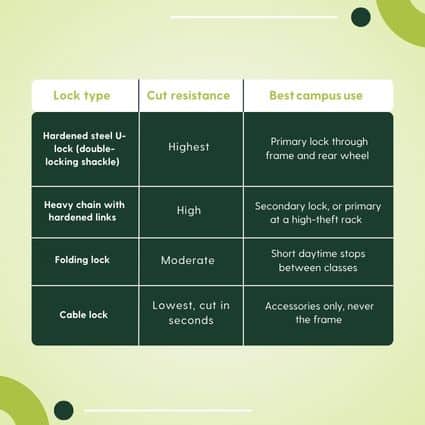
The best lock to prevent e-bike theft on campus is a hardened steel U-lock, ideally one with a double-locking shackle, paired with a secondary lock for the wheels. UC Berkeley’s police department and the University of Michigan’s Division of Public Safety and Security both recommend U-shaped e-bike locks, both also warn against relying on a cable lock alone, which can be cut by thieves in seconds.
This table compares the locks students most often bring to campus.
Where You Park Matters as Much as What You Lock It With
Where you park matters as much as what you lock it with. A few basic parking habits can help you keep your e-bike safe on campus. To deter thieves, use designated bike parking in a well-lit, high-traffic area covered by security cameras. Try to avoid leaving your e-bike in the same unattended spot every night. No lock is thief-proof, even the best lock won’t help if you leave your bike in an isolated spot where thieves have time to break it.

Should You Remove Your E-Bike Battery When You’re Not Riding?
E-bike battery safety overlaps with theft prevention. As the most expensive component of your e-bike, removing your battery pack when you are not riding makes your e-bike a less appealing target for thieves. Storing an e-bike battery indoors overnight also protects it from colder temperatures, extending its overall lifespan and performance. Take other detachable parts with you too. This includes your display screen and other valuable accessories.
E-Bike Registration, Tracking, and Insurance Before Something Happens
Registering your e-bike, enabling GPS tracking, and securing appropriate insurance enhance your e-bike theft protection, but they only work if you set them up before anything happens.

How to Register Your E-Bike with Campus Police
Registering your e-bike with campus police is usually free and takes a few minutes at the department office or an orientation table. Most departments record your serial number and issue a deterrent sticker, and some also partner with a national nonprofit registry like Bike Index, or 529 Garage. It’s also a good idea to photograph the bike from both sides and store the serial number somewhere other than your phone.
GPS Trackers Improve Recovery Odds, Not Prevention
A GPS tracker for e-bike owners will not stop theft, but it increases the likelihood that you will get it back. According to Bicycle Law, police recover nearly half of all stolen bikes, yet only 5% are returned to their owners.
A Bluetooth tag reports a position when someone’s phone passes close by. While this works well on a dense campus, it does not work very well once the bike is taken to a storage unit or a rural garage. A true GPS tracker reports its own position anywhere with cell service, but it costs more and usually carries a monthly subscription. Never go to the location of your stolen bike yourself, report it, and let the police handle it.
Renters Insurance Rarely Covers a Stolen E-Bike
Renters’ insurance for e-bikes is less reliable than most students realize. Standard policies often exclude e-bikes outright, because they are classified as motorized vehicles rather than ordinary personal property. The policies that cover bicycles usually cap payouts between $500 and $1,000.
The fix is a dedicated e-bike policy, which provides coverage that includes theft. These policies often provide replacement cost rather than depreciated value, and optional liability or transit coverage. Make sure to check the deductible before you invest in insurance.
What to Do If Your E-Bike Is Stolen
Acting fast after a theft increases the odds of recovery. If your e-bike is stolen, report it to police, if stolen on campus, report it to campus police. Provide the serial number, registration record (which includes make/model), and your photos. Then mark the bike stolen on Bike Index or 529 Garage and notify your insurer. The faster you report the theft, the higher the likelihood of successful recovery. Check local resale listings and share pertinent findings with the police.
Summary of 6 Essential Steps to Prevent and Manage Campus E-Bike Theft
As Forbes puts it, the best e-bike for a college student is the one that doesn’t get stolen. While no strategy is foolproof, you can drastically lower your risk by:
- Using a heavy-duty lock
- Removing the battery
- Parking in high-visibility areas
- Using a tracker
- Registering your e-bike
- Securing insurance
Finance and Protect Your E-Bike a Clean Energy CU
E-bike theft prevention is worth it, and so is choosing the right lender. Locks, registration, and insurance protect the bike while the loan behind it protects your finances. There is no better lender than Clean Energy CU. This not-for-profit cooperative is owned by its members, not shareholders, so surplus returns to members through loan pricing rather than stockholder dividends. Whether you want to refinance or apply for a new electric bicycle loan, check out Clean Energy CU and see if you qualify for the Clean Energy for All rate discount.
Note: All loans are subject to credit approval.